Why Cleaning Services Differ
This is a subtitle for your new post
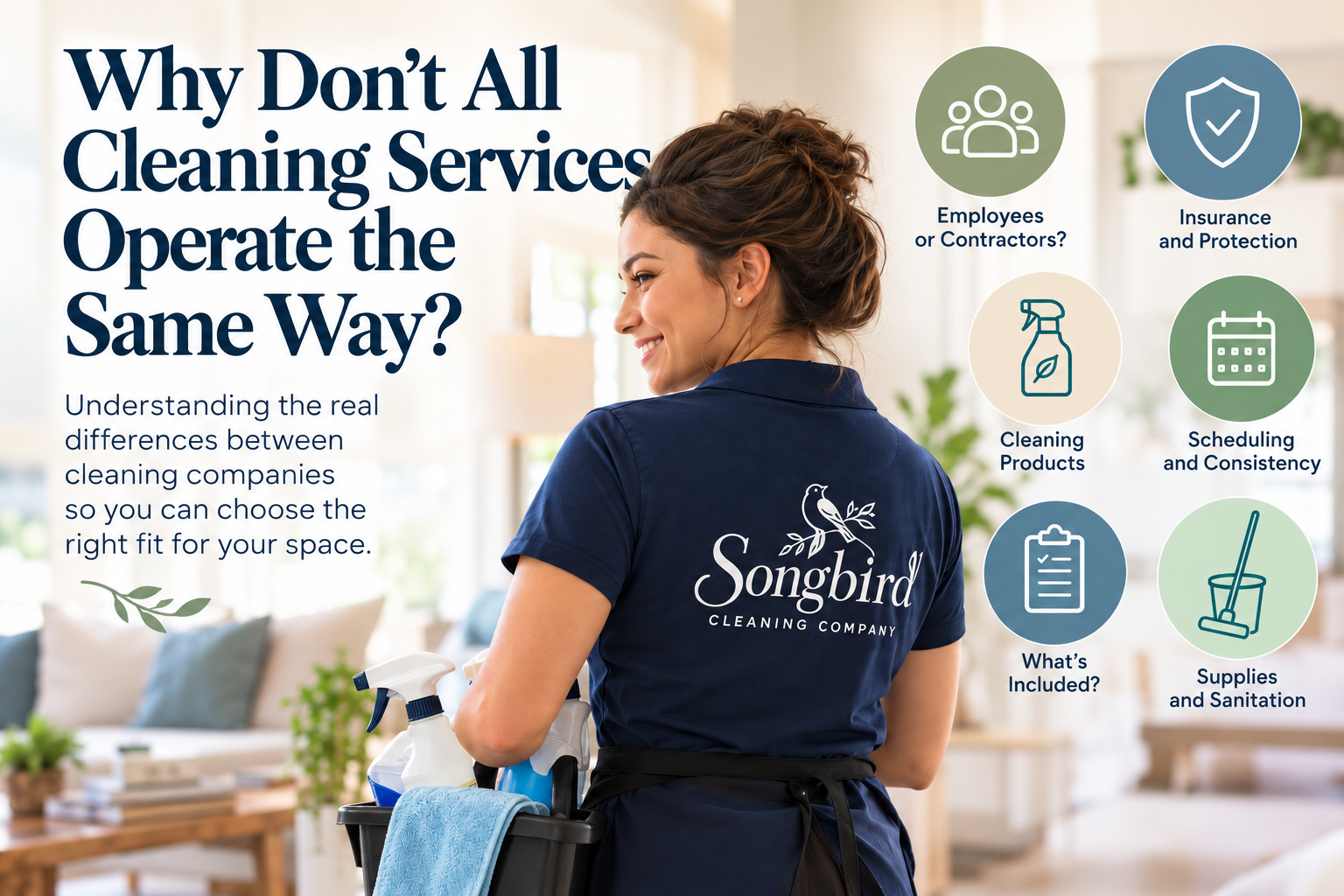
Why Don’t All Cleaning Services Operate the Same Way?
When I first started Songbird Cleaning Company, I spent a lot of time talking with and interviewing other cleaning company owners.
One of the things that surprised me most was just how differently cleaning companies operate.
You might assume that hiring a cleaning service is fairly straightforward. Someone comes to your home, cleans it, and leaves.
But what does "clean" actually mean?
That's where things get complicated.
Cleaning is incredibly subjective. What one person considers perfectly clean may look completely different from what someone else considers clean. And the differences between cleaning companies go far beyond which surfaces they wipe or how they clean a bathroom.
Companies make very different decisions about their employees, training, safety practices, products, insurance, scheduling, communication, equipment, and what is—or isn't—included in their service.
That's why two professional cleaning companies can offer what sounds like the same service and provide two very different experiences.
Cleaning Isn't a Standardized Service.
Think about what happens in your home every day.
You cook and clean up afterward. You manage your belongings. You pick things up, put things away, and handle the everyday tasks required to keep your household running.
A professional cleaning service comes in periodically to take care of the more tedious jobs—the things that require additional time, effort, expertise, or specialized equipment.
But exactly where everyday household maintenance ends and professional cleaning begins varies from company to company.
Windows are a good example.
Some clients assume their interior windows will be cleaned during every appointment. At Songbird, we generally consider interior window cleaning a periodic maintenance task rather than something that needs to be completed during every recurring cleaning.
That doesn't mean we can't clean them. We absolutely can discuss adding them according to a client's preferences.
It simply means they aren't automatically part of every service.
Neither approach is inherently right or wrong. What's important is that you know what you're purchasing before the cleaning begins.
Sometimes a Company's Policies Are About Safety, Not Cleaning.
Occasionally, a client will ask us to clean décor or another item located on a high ledge.
They may even say, "There's a ladder in the garage. You're welcome to use it."
That sounds like a simple solution.
For us, however, climbing ladders is outside the scope of the work our technicians are permitted to perform.
A client might understandably be confused, especially if a previous cleaning provider climbed the same ladder without hesitation.
But there's much more happening behind that decision than whether we're willing to dust something.
As an employer, I'm responsible for creating safe working conditions for my employees. Insurance carriers also evaluate the risks associated with the work a company performs. What equipment employees use and what they're expected to do while working inside someone's home matter.
So sometimes when a professional cleaning company says, "We don't do that," it isn't because the company doesn't want to accommodate you.
There may be a safety, liability, training, or insurance reason behind the policy.
The Person Cleaning Your Home May Be an Employee or an Independent Contractor.
This is one of the biggest differences consumers may never think to ask about.
When I created Songbird Cleaning Company, one of my priorities was building a people-first company.
My philosophy is simple: create great jobs for employees, and those employees are better positioned to provide great service to clients.
That's why Songbird uses background-checked W-2 employees.
Our employees receive a fair wage, mileage reimbursement, training, uniforms, and the supplies they need to perform their jobs.
That structure was very important to me.
I wouldn't want to send someone into a client's home unless I had properly vetted and trained that person.
Some cleaning companies operate differently and use independent contractors. That model can work, but consumers should understand that a true independent contractor is operating as an independent business rather than simply being another type of employee.
Worker classification depends on multiple factors, including the level of control a business exercises over how the work is performed. Things like training, scheduling, equipment, supplies, and other aspects of the working relationship can be relevant when determining whether someone is properly classified.
As a consumer, you don't need to become an employment-law expert.
But you should know who is entering your home and what relationship they have with the company you hired.
"We're Insured" Is Only the Beginning of the Conversation.
Another area where cleaning companies can operate very differently is insurance.
It's easy to see "licensed and insured" on a website and assume that tells you everything you need to know.
It doesn't.
When I established Songbird, I wanted appropriate coverage in place to protect our employees, our clients, and the company.
Songbird carries general liability insurance, workers' compensation coverage, and a bond.
Insurance can become more complicated when a company uses subcontractors because those individuals or businesses may be responsible for maintaining their own coverage. That's why simply asking, "Are you insured?" may not give you enough information.
A better question is:
"Can you explain how your insurance protects me and the people performing the work in my home?"
A professional company should be comfortable having that conversation.
The Cleaning Products Matter to Me Personally.
The products a cleaning company chooses are another example of something clients may never think about.
This issue became personal for me.
My dad always said that I inherited his mother's lungs. She and I both dealt with significant asthma.
When I began researching products for Songbird, I became very interested in what our technicians would be exposed to while working every day.
A homeowner may use a cleaning product for a few minutes once a week.
A professional cleaning technician is exposed to cleaning products for hours every working day.
That's a very different level of occupational exposure.
So I didn't just want products that worked.
I wanted to find a professional product system that could effectively clean and sanitize while also being mindful of the people using those products repeatedly.
That became an important part of how we chose the products used by Songbird.
Another cleaning company may make completely different product choices.
That's why asking "What products do you use?" is a perfectly reasonable question.
Ask About the Rags and Mop Heads Too.
Here's a question almost nobody thinks to ask:
"What do you do with your cleaning cloths and mop heads?"
It may not be glamorous, but it's important.
Ask how reusable cleaning supplies are handled, laundered, separated, and maintained.
Professional cleaning isn't only about whether someone knows how to make a faucet shine.
The systems behind the cleaning matter too.
Sanitation practices, equipment maintenance, product selection, and how supplies are handled from one appointment to another are all part of the service you're purchasing—even though you may never see those systems in action.
Will You Have the Same Cleaner Every Time?
Scheduling is another area where companies can be dramatically different.
Some companies send whoever is available.
Some rotate teams.
Some provide arrival windows rather than specific appointments.
Some companies operate on standing schedules.
Through experience, I've learned how valuable stability is for both clients and cleaning technicians.
Our recurring weekly and biweekly clients have standing appointments, and we work to provide consistency in technician assignments.
Why?
Because relationships matter.
A technician who regularly cleans a particular space begins to understand it.
They learn the flooring. They become familiar with the surfaces. They know the areas that need extra attention. They understand the flow of the space and the client's preferences.
The technician also knows what was addressed during the previous visit and what may need attention this time.
At the same time, employees benefit from having a predictable schedule and knowing the clients and spaces they'll be serving.
That stability creates a better experience on both sides.
One of My Biggest Lessons Was That Verbal Explanations Aren't Enough.
Early in Songbird's development, we explained our services verbally.
It seemed reasonable. We'd talk with the client, explain what was included, answer questions, and schedule the service.
Then experience taught me something:
People don't always remember conversations the same way.
And that's especially problematic in an industry where the service itself is subjective.
So we changed our process.
Today, we use our Harmony Service Guide to clearly outline what's included in our different service levels.
Clients can read the information themselves, identify what's important to them, and ask questions before their appointment.
It has been far more effective than relying solely on verbal explanations.
I've learned that one of the best ways to prevent disappointment isn't to promise more.
It's to communicate more clearly.
Different Doesn't Necessarily Mean Wrong.
This may be the most important point I can make as a cleaning company owner.
Just because another cleaning company operates differently from Songbird doesn't necessarily mean they're doing something wrong.
They may have a different business model.
They may define their scope differently.
They may use different products.
They may use independent contractors.
They may include windows with every service.
They may allow their workers to perform tasks that fall outside our safety policies.
The important question isn't necessarily:
"Which cleaning company does everything the right way?"
A better question is:
"Does this company's way of operating align with what's important to me?"
That's why consumers should look beyond price when comparing cleaning services.
Questions to Ask Before Hiring a Cleaning Company
Before allowing someone into your home, I recommend asking a few questions:
- Do you use employees or independent contractors?
- Are the people entering my home background checked and trained?
- Can you tell me about the cleaning products you'll use?
- How do you handle supplies such as cleaning cloths and mop heads?
- Can you explain how your insurance protects me and the people working in my home?
- Will I typically have the same cleaner or team?
- Will I have a standing appointment if I become a recurring client?
- Do you have a written checklist or service guide showing exactly what's included?
Don't be afraid to ask follow-up questions.
A cleaning company is sending people into one of your most personal spaces. You have every right to understand how that company operates.
You're Buying More Than a Cleaning Space.
When you hire a professional cleaning service, the visible result matters.
Of course you want clean floors, sparkling bathrooms, dust-free surfaces, and a kitchen that feels refreshed.
But you're purchasing much more than the cleaning tasks themselves.
You're also choosing the systems behind them.
You're choosing how workers are vetted and trained.
You're choosing what products enter your space.
You're choosing the company's approach to safety.
You're choosing how clearly expectations are communicated.
You're choosing whether your schedule will be predictable.
And you're choosing the people you're allowing into your home.
At Songbird Cleaning Company, we've made those decisions very intentionally.
We're still learning. We're still refining our systems. And experience continues to teach us better ways to serve both our clients and our employees.
That's part of building a professional cleaning company.
Because ultimately, professional cleaning isn't just about what gets cleaned.
It's also about who is doing the cleaning, how they're cared for, how the work is performed, and what happens behind the scenes to make the experience safe, consistent, and dependable.